

Water 2025
General Introduction
There is a finite amount of water on Earth. The increase in global demand for water not only creates a risk for your business but creates a risk for your community and planet on a broader scale. The operational, environmental, and financial impacts of water use are key issues for facility operations. Driving efficient water use and reductions throughout facility operations is an important area of focus for all factories.
In general, the Higg FEM Water section encourages you to:
- Identify and understand all water sources and uses at the facility.
- Understand what operations and processes at your facility use the most water.
- Track and report the quantity of water consumption at your facility.
- Evaluate, plan for, and adopt solutions to reduce water use through better manufacturing practices and water reuse/recycling.
- Implement leading practices to reduce water use at your facility.
- Contribute to sustainable water management and water stewardship activities in your community.
Additional details on the intent and criteria for each Higg FEM Water question is provided in the guidance below along with useful technical guidance and resources to support your facility in the management and reduction of water usage.
Water Use at Your Facility
In the Higg FEM, water use is categorized as either used for production or domestic purposes as defined below:
- Water used for Production: Water used in manufacturing processes or operations used to make goods (e.g., dyeing or rinse water, steam generation, water used in mixtures applied to the product, cleaning of equipment components or tools that contact the product during the manufacturing process, etc.)
- Water used for Domestic Purposes: Water used for washrooms, sanitation, drinking, food preparation, landscape irrigation, non-contact cooling etc.
The Higg FEM requires facilities to select the sources of water used at their facility. The FEM includes a list of predefined sources that can be selected. The table below provides a description of the available water source options in the FEM. These are categorized blue and grey water sources.
Blue Water Sources
Blue water is fresh surface and groundwater, in other words, the water in freshwater lakes, rivers and aquifers
| Water Source | Description |
| Surface Water | Water that is naturally occurring on the Earth’s surface (ice sheets, ice caps, glaciers, icebergs, ponds, lakes, rivers / streams, wetlands, bogs, etc.) Surface water has a low concentration of dissolved solids, is of an acceptable quality, and/or requires minimal treatment to be used for domestic, municipal, or agricultural applications. |
| Groundwater | Water in soil beneath the soil surface, usually under conditions where the pressure in the water is greater than the atmospheric pressure, and the soil voids are substantially filled with the water. Non-renewable groundwater is generally located at deeper depths and cannot be replenished easily or is replenished over very long periods of time. They are sometimes referred to as “fossil” groundwater sources. |
| Municipal Blue Water | Water provided by a municipality or other public provider that is generated by blue water. |
| Municipal Water (Origin Unknown) | Water provided by a municipality or other public provider with unknown origin (e.g., blue, or grey water) |
| Brackish surface water/seawater | Water in which the concentration of salts is relatively high (over 10,000 mg/l). For comparison, seawater has a typical concentration of salts above 35,000 mg/l. Brackish water is saltier than fresh water, but not as salty as seawater. It may result from mixing of seawater with freshwater, as in estuaries, but also certain human activities can produce brackish water. Brackish water is hostile to the growth of most terrestrial plant species. |
| Condensate from External Steam Source | Water that is generated from the condensate of steam sources that are not located at the facility. |
| Rainwater | Water in the form of precipitation (e.g., rain, snow) that is harvested within the facility either from the roof or other surfaces and stored for use. |
Grey Water Sources
Grey water is water that has been polluted by human activity (e.g., industrial, or domestic sources)
| Water Source | Description |
| Municipal Grey Water | Water provided by a municipality or other public provider that is generated by grey water. |
| Recycled Water | Wastewater that has been treated using physical, chemical, and/or any additional treatment processes to meet a quality which allows the water to be used again in a process or for domestic purposes. For example, wastewater that has gone through a membrane filtration process and used back in the industrial operation is considered recycled water. This does not include water cycled in operations such as cooling towers and non-contact heat exchange operations. |
| Reuse Water | Wastewater discharged from one process that is used directly in another process without treatment. This does not include water cycled in operations such as cooling towers and non-contact heat exchange operations. |
| Treated Wastewater from External Source | Wastewater that has been discharged and treated by an external source (e.g., other manufacturing facility) using physical, chemical, and/or any additional treatment processes to meet a quality which allows the water to be used again in a process. |
| Untreated Wastewater from External Sources (treated internally) | Wastewater that has been discharged by an external source (e.g., other manufacturing facility) and treated at your facility using physical, chemical, and/or any additional treatment processes to meet a quality which allows the water to be used again in a process. |
Water Data Quality
Accurately tracking and reporting water use data overtime provides facilities and stakeholders with detailed insight into opportunities for improvement. If data is not accurate, this limits the ability to understand a facility’s water use footprint and identify the specific actions that will help reduce environmental impacts and drive efficiencies. When establishing a water tracking and reporting program, the following principles should be applied:
- Completeness – The tracking and reporting program should include all relevant sources (as listed in the FEM). Sources should not be excluded from data tracking and reporting should be based on materiality (e.g., small quantity exceptions).
- Accuracy – Ensure that the data input into the water tracking program is accurate and is derived from credible sources (e.g., calibrated meters, established scientific measurement principles or engineering estimates, etc.)
- Consistency – Use consistent methodologies to track water data that allows for comparisons of water use over time. If there are any changes in the tracking methods, water sources, or other operations that impact water use data, this should be documented.
- Transparency – All data sources (e.g., water bills, meter readings, etc.), assumptions used (e.g., estimation techniques), and calculation methodologies should be disclosed in data inventories and be readily verifiable via documented records and supporting evidence.
- Data Quality Management – Quality assurance activities (internal or external data quality checks) should be defined and performed on water data as well as the processes used to collect and track data to ensure reported data is accurate.
Applicability Questions
To determine which questions you will need to complete in the Water section, you will need to complete the applicability questions listed below.
Based on the response to the applicability questions, facilities will be classified as a high or low water user, and a facility in an area of high or low water risk as follows:
- Facilities with low water use (defined as using less than 35m3 per operating day)
- Facilities with high water use (defined as using equal to or greater than 35m3 per operating day)
- Facility located in an area of low water risk (as defined by the WRI Aqueduct Tool or the WWF Water Risk Filter).
- Facility located in an area of high water risk (as defined by the WRI Aqueduct Tool or the WWF Water Risk Filter).
Facilities that are classified as either high water users or located in an area of high water risk (or both) will be asked to complete all FEM questions in the water section. Facilities classified as low water users that are located in areas of low water risk will only answer Level 1 questions.
1. How many days did your facility operate during this reporting year?
- List the number of days the facility operated in the reporting year.
- Note: Refer to the Site Information & Permits Section of the Higg FEM guidance on how to determine the number of operating days.
2. Select the tool used to assess your facility’s water risk.
- WWF
- WRI
Facilities will be asked to evaluate their water risk using both the WRI Aqueduct Tool and the WWF Water Risk Filter.
Notes:
- Facilities must report their water risk based on the highest water risk ratings from the two tools (e.g., if the WRI tool shows low risk and the WWF tool shows high risk, the high risk must be reported).
- Facilities should capture screenshots and/or downloads of the risk assessment outcome and upload as evidence to show that the risk assessment was done within the FEM reporting year.
The WRI Aqueduct Tool and the WWF Water Risk Filter are simple and similar tools to assess water scarcity risks.
When using the WRI Aqueduct Tool go to the home page and select explore global water risk maps and select Enter Address at the bottom of the screen to search using your facility address. Facility should select the default Overall Water Risk weighing scheme.
When using WWF Water Risk Filter, click on the maps feature under the Water Risk menu option and search for your country and location. Look at the color-coding of the map to determine the Basin Physical risk for the area your facility is located . This link provides information on the data and methodology and scoring matrix used in the Risk Filter.
Note: “Low risk”, “Low to medium risk” and “Medium to high risk” are defined as “Low risk” in FEM. “High risk” and “Extremely/Very high risk” are defined as “High risk” in FEM.
3. Is your facility location rated as high/very high for overall water risk using this tool?
- Yes
- No
4. Is your facility using water for production use?
- Yes
- No
5. Is your facility able to separately report water consumption by each facility type?
- Yes
- No
Answer Yes If: Your facility tracks water consumption separately for the different facility types selected in the Site Info Section of the FEM.
Note: This applicability question will only apply to facilities that have selected “Finished Product Assembler” AND “Finished Product Processing” as the only two facility types in the Site Info Section of the FEM.
Level 2
Higg FEM Level Progression
If your facility did not achieve Level 1 in this section or is considered as a low water user/low water risk facility, you will have the option to complete Level 2 and 3 questions and will be asked one of the following questions:
Your facility has not achieved Level 1 within this section, the maximum score for this section will be limited to your answers in Level 1, You now have the option to answer Level 2 and Level 3 questions, would you prefer to proceed answering these additional questions?
If you Answer Yes: Level 2 and 3 questions will be available to answer in this section.
If you Answer No: Level 2 and 3 questions will not be available in this section.
Notes:
- If your facility did not achieve Level 1 in this section, answering Level 2 and 3 questions will not result in additional score beyond what you have already achieved in Level 1
- It is recommended that facilities consult with their business partners on whether they require responses to Level 2 and Level 3 questions, even though you have not achieved Level 1 in this specific section.
- Facilities are encouraged to complete Level 2 and Level 3 questions when possible as these can provide valuable insights on your facilities environmental performance and opportunities for improvement with the advanced Higg FEM aspects in Level 2 and 3.
Your facility is considered as a low water user / low water risk facility, the maximum score for this section will be based on your answers in Level 1 and will be out of 100 full points, you now have the option to answer Level 2 and Level 3 questions, would you prefer to proceed answering these additional questions?
If you Answer Yes: Level 2 and 3 questions will be available to answer in this section.
If you Answer No: Level 2 and 3 questions will not be available in this section.
Notes:
- Answering Level 2 and 3 questions will not result in an additional score beyond what you have already achieved in Level 1, as your Level 1 questions already account for 100% of your points for this section.
- It is recommended that facilities consult with their business partners on whether they require responses to Level 2 and Level 3 questions, even though you are a low water use/ low water risk facility.
- Facilities are encouraged to complete Level 2 and Level 3 questions when possible as these can provide valuable insights on your facilities environmental performance and opportunities for improvement with the advanced Higg FEM aspects in Level 2 and 3.
-
Answer Yes if: Your facility has set a baseline for one (1) or more water sources.
Note: In the FEM, baselines must be based on data from within the past 5 years. (e.g. For FEM 202X the earliest possible baseline is 202(X-5).)
If you answer Yes to this question, you will be asked to complete a series of question and tables based on your facility’s water use applicability with the following questions to provide details on your baselines for each applicable water source (All applicable water sources will be pre-populated in the tables)
-
- Note: This question only applies to facilities that use water in production and track production and domestic water use separately.
This question is not scored in the 2025 Higg FEM reporting year. Scoring may be applied in future reporting years.
-
- Have you set a baseline for this water source?
- Is this a normalized or absolute baseline?
- If normalized, are you setting separate baselines based on your facility type?
- Notes:
- This only question applies to facilities that use water in production.
- If your facility selected multiple facility types in the facility profile structure section of the FEM (e.g., Finished Product Assembler and Material Production), and you set baselines for each facility type, a separate table for baseline data will be displayed for each selected facility type.
- Notes:
- Facilities that use water for production and do not separately track or set baselines for production and domestic water use will complete one (1) baseline table for combined production and domestic water use.
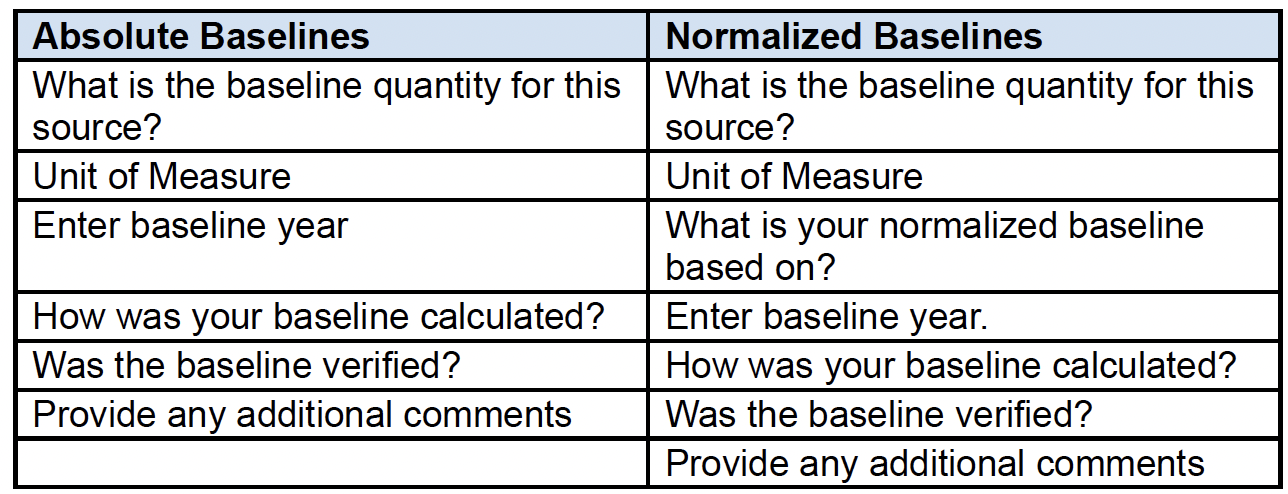
- Facilities that use water in production and separately track and have set baselines for production and domestic use separately will complete separate baseline tables for production and domestic water use. For all water sources that have baselines, you will be asked to complete a table with the following questions based on whether the baseline is absolute or normalized:
- Notes:
Suggested Uploads:
- Documentation that supports how the baseline was established for each water source (e.g., water use tracking data and production data from the baseline year, supporting calculations or assumptions used to determine the baseline).
- What is the intent of the question?
- The intent of this question is for facilities to demonstrate that they have established baselines for water use at the facility so that future reduction efforts can be quantified.
- Technical Guidance:
- A “baseline” is a starting point or benchmark that a facility can use to compare changes over time and quantify any reduction efforts. Baselines can be absolute or normalized.
For example:
- Absolute: The total amount of water used for a period of time. (e.g., 1,500,000 of municipal water used in the reporting year)
- Normalized: The amount of water used while making a unit of product (e.g., 0.15 m3 per pair of shoes produced).
- Note: It is recommended to use the ‘Normalized’ method to account for operational fluctuations. Normalized baselines provide more accurate and useful comparisons over time.
- When establishing a baseline, be sure to do the following:
- Confirm the water source data is stable, and sufficient to be used to determine a baseline. In the Higg FEM, a baseline should generally comprise of a full calendar year’s data.
- Note: If your factory has undergone major structural or operational changes such as acquisition or changes in product type, in general, you should establish or reset a baseline after those changes have been completed.
- In the FEM, baselines must be re-evaluated and reset at least every 5 years to ensure they represent current operations. (e.g. For FEM 202X the earliest possible baseline will be 202(X-5).)
- Determine if the baseline will be Absolute or Normalized (Normalized baselines are preferred)
- Verify the source data and normalizing metrics data is accurate. o Water and production volume data from previous Higg FEM verifications, internal or external audits conducted by qualified personnel are acceptable sources of data verification.
- Apply the appropriate baseline metric (i.e., per year for absolute OR divide by the chosen normalizing metric 150,000 m3 per 1,000,000 pieces = 0.15m3/piece)
- Note: For water consumption that is not related to production, other normalizing metrics should be used where appropriate (e.g., water consumption per worker). Note: If the baseline is used to evaluate performance against a target, the baseline should remain unchanged.
- Confirm the water source data is stable, and sufficient to be used to determine a baseline. In the Higg FEM, a baseline should generally comprise of a full calendar year’s data.
Reporting baseline data in Higg FEM:
Do:
✔ Review source data and raw normalizing metric data (utility invoices, meter logs, production quantity, etc.) against aggregated totals used to determine the baseline(s) to ensure they are accurate. (e.g., double check monthly water consumption records to ensure they match the annual consumption quantities used to calculate the baseline).
✔ Select the appropriate baseline type in the FEM – Absolute or Normalized.
✔ Ensure the proper units are reported and verify any unit conversions from source data to reported data.
✔ Enter the baseline year. This is the year the baseline data represents.
✔ Provide sufficient details on how the baseline was calculated (e.g., water consumption was normalized per meter of fabric produced).
✔ Only select Yes to the question “Was the baseline verified?” if the baseline data was fully verified in a previous Higg FEM verification, or by an internal or externalaudit conducted by qualified personnel.
Do Not:
X Report a baseline that is not accurate (e.g., the data source is unknown or has not been verified)
X Report a baseline that is based on insufficient data (e.g., not a full year’s data).
X Report an estimated baseline if it is not supported by verifiable and accurate estimation methodology and data (e.g., engineering calculations).
How This Will Be Verified:
When verifying a facility’s baselines, Verifiers must review:
● All source data (utility invoices, metering logs, production quantity) and aggregated data totals for the baseline year; and/or
● Records of baseline data verification where available (e.g., previous Higg Verification, data quality review, internal or external audits, etc.)
If any inconsistencies or errors are noted, the reported information must be corrected where possible and detailed comments should be included in the Verification Data field.
Full Points: Full Points will be awarded if the facility has established baselines for all water applicable sources.
Documentation Required:
● Documentation that supports how the baseline was established for each water source. This may include: o Water use tracking and production data from the baseline year (separated by production and domestic use, if applicable). o Supporting calculations methodologies or assumptions used to determine the baseline.
● Supporting evidence to demonstrate how baseline data was validated (e.g., verified Higg FEM data for the baseline year, external or internal data validation process or report).
Interview Questions to Ask:
● Staff responsible for water management are able to describe how the baselines were determined including any normalizing metrics used or any assumption made in the calculation methodology.
● Relevant staff are able to describe the facility’s process to validate the accuracy of baseline data.
Inspection – Things to Physically Look For:
● The observed water management practices on-site are consistent with the facility’s reported methods for determining baselines (e.g., water sources used, water use tracking methods/equipment, etc.)
● Observations on-site do not indicate that there have been significant changes at the facility that could impact the appropriateness of the baseline (e.g., new production areas, changes to products, new buildings, etc.)
Partial Points:
● Partial points will be awarded if the facility has established baselines for one (1) or more, but not all applicable water sources.
-
Answer Yes if: Your facility has a current water balance or another analysis (e.g., water audit) that covers water intake, usage and output to evaluate water use at the facility.
Note: For this question “current” means that the water balance or other analysis accurately reflects facility operations and water use in the Higg FEM reporting year and was conducted no more than 5 years before the FEM reporting year (e.g., if the analysis was performed no more than 5 years before the reporting year and this reflects the facility operations and water use in the reporting year this analysis is considered acceptable).
If you select Yes, you will be asked the following sub question(s) to provide details on your water balance or other analysis:
- Which one of the below activities were conducted to evaluate and trace water intake against usage and output? Select all that apply.
- Conduct water balance / analysis.
- Please upload a copy of the water balance / analysis report
- Conduct water audit in last 5 years.
- Please upload a copy of the water audit report
- Other
- If Other, please describe.
- Please upload the methodology used for the above analysis.
- If you do not have a document to upload, describe your methodology here.
- Conduct water balance / analysis.
- From the above analysis, has your facility identified the highest water use processes or operations?
- List down the highest water use processes or operations at your facility (from highest to lowest) that account for 80% of your water use?
Suggested Uploads:
- Documentation that demonstrates the facility has conducted a water balance or other analysis to evaluate water usage at the facility (e.g., water balance or audit report, other documented methodology for analysing the water use, etc)
- Supporting documentation that shows the ranking of processes or operations based on water consumption.
What is the intent of the question?
The intent of this question is for facilities to demonstrate that a formal analysis of water use has been conducted to identify and quantify areas of significant water use or potential loss.
Technical Guidance
Understanding the production and operational aspects that influence water use at a facility allows facilities to identify and prioritize actions to reduce water use. A water balance or other water use analysis along with historical water use data and water costs will help build a facility’s understanding of overall water use factors at the facility and highlight water reduction and cost savings opportunities.
The steps below provide an overview of the key steps involved in analyzing water use at a facility:
- Data Collection: Collect information on water use (e.g., water meter readings, water bills records, process-specific water consumption data, etc.)
- Water Flow Mapping: Create a flow diagram of the facility’s water system, including water intake, usage in domestic/production processes, and discharge to wastewater treatment. This helps visualize the flow of water through the facility and identify areas of potential water loss or inefficiency.
- Measurement and Verification: Confirm the accuracy of water meter readings and other data sources and identify any discrepancies that may indicate leaks or other issues.
- Water Use Analysis: Analyze the collected data to identify patterns and trends in water use, including high water-consuming processes/equipment, seasonal variations, and areas for improvement.
Common tools used to analyse water usage at a facility include a water balance or water audit. Similar in nature, these tools can be used to quantify water intake and outputs for a facility, process/operation and/or piece of equipment. To establish a full understanding of water usage (intake and outputs) at a facility the analysis should include a focus on :
- The incoming water in the facility (e.g., the quantity and water sources)
- The quantity of water used during the production processes.
- The quantity of water recycled/reused in the facility.
- The volume of water discharged to and from any treatment systems (incoming or wastewater).
- The frequency which the analysis is reviewed and/or updated to ensure water use variability is well understood.
- Note: The more frequently a water balance/analysis is reviewed, the greater understanding one can have on facility water use and variability.
In theory, the total quantity of water influent into a facility should be equal to the total quantity discharged minus any losses (e.g., influent – effluent = 0) However, in practice, the realized difference between influent and effluent upon analysis is rarely zero. This can be due to leakage, evaporation (intended or unintended), errors in measurement, etc. Differences of less than 10-15% of total water use may be normal depending on facility operations, analysis methodology, and/or measurement techniques used, however larger differences (e.g., greater than 25% of total water) or a water balance of exactly 0 or a negative amount is usually indicative of an error. This would typically indicate a problem in the analysis or potentially due to unknown sources of water loss and should be investigated.
Below is an example of a basic water analysis map that shows inflows and outflows of water in a facility:

Source: http://www.sciencedirect.com/science/article/pii/S2212371716300221
Resources:
- Steps in a Water Audit http://www.facilitiesnet.com/green/article/Steps-in-a-Water-Audit-Facilities-Management-Green-Feature–9364
- Water Audit Data Collection Sheet https://www.brewersassociation.org/attachments/0001/1518/Water_Water_Audit_Data_checklist.pdf
- Water calculation tool for the textile wet processing sector https://watercalculator.dnvgl.com
- American Water Works Association (AWWA) – Water Audit Software and Guidance: https://www.awwa.org/Resources-Tools/Resource-Topics/Water-Loss-Control
How This Will Be Verified:
Full Points:
Full points will be awarded to facilities that have current water balance or another analysis (e.g., water audit) that covers water intake, usage, and output to evaluate water use at the facility that was conducted within 5 years of the FEM reporting year.
Documentation Required:
- Documentation that demonstrates the facility has conducted a water balance or other analysis to evaluate water usage at the facility. This may include:
- Water balance or water audit report
- Other documented methodology for analysing the water use.
- If applicable, supporting documentation that shows the ranking of processes or operations based on water consumption quantity (e.g., highest to lowest).
Interview Questions to Ask:
- Staff responsible for water management at the facility can explain how water usage (intake, usage, and outputs) was analysed and how the facility identifies and ranks the highest water consumption processes or operations, if applicable.
Inspection – Things to Physically Look For:
- Observations indicate that the facility’s water usage analysis (e.g., water balance or audit) is representative of current facility operations and water use observed onsite.
Partial Points: N/A
- Which one of the below activities were conducted to evaluate and trace water intake against usage and output? Select all that apply.
-
Answer Yes if: Your facility has set a target to reduce blue water use for one (1) or more sources.
Notes:
- Targets for rainwater use reductions or increases should not be reported in this question.
- If your facility has not conducted a formal evaluation of water reduction opportunities and calculated how much blue water can be reduced to support your target, you should select No for this question.
- For the definition of blue water sources, please refer to the Introduction Section of the water guidance.
If you answer Yes to this question, you will be asked to complete a series of tables with the following questions to provide details on your targets for each applicable blue water source (All applicable blue water sources will be pre-populated in the tables):
- Select all sources of blue water for which your facility has set a water reduction target.
- Have you set a target for this water source?
- Is this a normalized or absolute target?
- If normalized, are you setting separate targets based on your facility type?
- Note: If your facility selected multiple facility types in the facility profile structure section of the FEM (e.g., Finished Product Assembler and Material Production), and you set targets for each facility type, a separate table for target data will be displayed for each selected facility type.
For all sources that have targets, you will be asked to complete a table with the following questions based on whether the target is absolute or normalized:

Absolute Targets Normalized TargetsWhat is your target for change in water use from this source? (Enter negative value for reduction target or positive value for increased target)What is your target for change (in %) in water use from this source? (Enter negative value for reduction target or positive value for increased target)Enter the target year.What is your normalized baseline based on?Describe the measures planned to achieve this target.Enter the target year. Describe the measures planned to achieve this target
Suggested Uploads:
- Documentation that supports how the target was established and demonstrates the target is based on a formal evaluation of reduction opportunities (e.g., water use data and baselines, new/proposed equipment specifications or work practices, etc.)
What is the intent of the question?
The intent of this question is for facilities to demonstrate that they have established formal targets to reduce blue water use at the facility.
Technical Guidance
Targets can use absolute or normalized metrics to drive quantifiable improvements by a set date compared to the baseline. For Higg FEM, reduction targets may be normalized to the production volume unit or another appropriate operational metric. A normalized target shows you when progress is real, rather than being a result of business changes such as reductions in production. An example of a normalized target is a reduction in the cubic metres of water used to produce one kilogram of sellable product (m3/kg).
When establishing formal reduction targets, be sure to do the following:
- Base the target on a formal evaluation of improvement opportunities and actions (e.g., equipment replacement or upgrades) to calculate the amount of water that can be reduced.
- For example: Setting a target based on an evaluation of installing a counter current rinsing system is expected to result in a 5% reduction in annual municipal water consumption per square meter of fabric produced that was calculated based on a formal review of the rinse system manufacturer’s specifications and the expected production requirements. OR a 10% reduction target that will be achieved by the installation of low flow water taps in all lavatories that was calculated based on the facility’s baseline water use data and the reduced flow rate of the taps to be installed.
- Define the exact target quantity, expressed as a percent (e.g., reduce normalized municipal water consumption per square meter of fabric by 5%). This must be based on a formal evaluation as noted above.
- Determine if the target will be Absolute or Normalized to a production or operating metric.
- Define the start date (i.e., “baseline”) of the target.
- Define the end date of the target, meaning the intended completion date of the required improvements.
- Define the appropriate measurement units.
- Establish procedures to review the target. This review should include an evaluation of the actions taken and progress on reaching the defined target. Quarterly reviews are recommended.
- Ensure the target is relevant to reducing the site’s water use (e.g., focuses on the most significant water uses at the site)
Reporting Targets in Higg FEM:
Do:
- Review the target to ensure all aspects noted above are covered and that the information is accurate.
- Enter the targeted reduction as a percentage. Make sure to enter a negative percentage for a reduction target (e.g. -5 for a 5% reduction).
- Provide sufficient details on how the target will be met in the “Describe the measures planned to achieve this target:” field (e.g., Achieve a 5% reduction in normalized municipal domestic water consumption per person by installing low flow fittings and self-closing taps on all taps in facility lavatories).
Do Not:
- Report a target that is not accurate (e.g., the data source is unknown or has not been verified)
- Report a target that is based on insufficient data. (e.g., a reduction target that is not based on a formal evaluation of options such as equipment upgrades to meet the stated target OR actions to meet the target have not been defined.)
- Report an estimated target if it is not supported by verifiable and accurate estimation methodology and data (e.g., engineering calculations).
How This Will Be Verified:
When verifying a facility’s targets, Verifiers must review:
- All supporting evidence (e.g., calculations, water use and baselines, new/proposed equipment specifications, etc) to verify the target is based on a formal evaluation of improvement opportunities.
- Facility operations in relation to its water sources and use to ensure targets and opportunities evaluated are relevant to the site’s water use.
If any inconsistencies or errors are noted, the reported information must be corrected where possible and detailed comments should be included in the Verification Data field.
Full Points:
Full Points will be awarded if the facility has established targets for one (1) or more blue water sources and the targets cover greater than 90% (by total blue water use in m3) of blue water used at the facility.
Documentation Required:
- Documentation that supports how the target was established for each water source and are based on a formal evaluation of reduction opportunities. This may include:
- Water tracking and production data.
- Documented evaluations of new/proposed equipment specifications, modifications to production processes or work practices that will result in water use reductions.
- Supporting calculations methodologies or assumptions used to determine the target.
Interview Questions to Ask:
- Staff responsible for water management can describe how the targets were determined including any calculations or assumptions made in the target setting methodology.
- Relevant staff can describe the facility’s proposed actions to achieve the target and how progress is monitored and tracked.
Inspection – Things to Physically Look For:
- The observed water management practices on-site are appropriate in relation to the established targets (e.g., water sources and tracking of water use, etc.)
Partial Points:
- Partial points will be awarded if the facility has established targets for one (1) or more blue water source and the targets cover 50% to 89% (by total blue water use in m3) of blue water used at the facility.
-
Answer Yes if: Your facility has set a target to increase grey water use for one (1) or more sources.
Notes:
- If your facility has not conducted a formal evaluation of opportunities to increase grey water use and calculated how much grey use can be increased to support your target, you should select No for this question.
- For the definition of grey water sources, please refer to the Introduction Section of the water guidance.
If you answer Yes to this question, you will be asked to complete a series of tables with the following questions to provide details on your targets for each applicable grey water source (All applicable grey water sources will be pre-populated in the tables):
- Select all sources of grey water for which your facility has set a water target.
- Have you set a target for this water source?
- Is this a normalized or absolute target?
- If normalized, are you setting separate targets based on your facility type?
- Note: If your facility selected multiple facility types in the facility profile structure section of the FEM (e.g., Finished Product Assembler and Material Production), and you set targets for each facility type, a separate table for target data will be displayed for each selected facility type.
For all sources that have targets, you will be asked to complete a table with the following questions based on whether the target is absolute or normalized:

Absolute Targets Normalized TargetsWhat is your target for change in water use from this source? (Enter negative value for reduction target or positive value for increased target)What is your target for change (in %) in water use from this source? (Enter negative value for reduction target or positive value for increased target)Enter the target year.What is your normalized baseline based on?Describe the measures planned to achieve this target.Enter the target year. Describe the measures planned to achieve this target
Suggested Uploads:
- Documentation that supports how the target was established and demonstrates the target is based on a formal evaluation of opportunities to increase grey water use (e.g., water use data and baselines, new/proposed equipment specifications or work practices, etc.)
What is the intent of the question?
The intent of this question is for facilities to demonstrate that they have established formal targets to increase grey water use at the facility.
Technical Guidance
Increasing the use of grey water through recycling and reuse programs allows a facility to reduce the amount of blue water used at the facility and supports efforts towards a closed loop system that reduces overall water consumption.
Targets can use absolute or normalized metrics to drive quantifiable improvements by a set date compared to the baseline. For Higg FEM, targets to increase grey water use may be normalized to the production volume unit or another appropriate operational metric. A normalized target shows you when progress is real, rather than being a result of business changes such as variation in production. An example of a normalized target is an increase in the cubic metres of grey water used per employee per day for domestic use (e.g., toilet flushing) (m3/employee per day).
When establishing formal targets to increase grey water use, be sure to do the following:
- Base the target on a formal evaluation of improvement opportunities and actions (e.g., equipment replacement or upgrades) to calculate the increase in the amount of grey water used.
- For example: Setting a target based on an evaluation of installing a grey water recycling system is expected to result in a 5% in grey water use per employee per day that was calculated based on a formal review of the system manufacturer’s specifications and the grey water usage baseline.
- Define the exact target quantity, expressed as a percent (e.g., increase the amount of grey water recycled and used per piece in the screen washing department by 5%). This must be based on a formal evaluation as noted above.
- Determine if the target will be Absolute or Normalized to a production or operating metric.
- Define the start date (i.e., “baseline”) of the target.
- Define the end date of the target, meaning the intended completion date of the required improvements.
- Define the appropriate measurement units.
- Establish procedures to review the target. This review should include an evaluation of the actions taken and progress on reaching the defined target. Quarterly reviews are recommended.
- Ensure the target is relevant to increasing the site’s grey water use.
Reporting Targets in Higg FEM:
Do:
- Review the target to ensure all aspects noted above are covered and that the information is accurate.
- Enter the targeted increase as a percentage. Make sure to enter a positive percentage for a target to increase use (e.g., 5 for a 5% increase).
- Provide sufficient details on how the target will be met in the “Describe the measures planned to achieve this target:” field (e.g., Achieve a 20% increase in grey re-use per person by installing a grey water recycling system in facility lavatories).
Do Not:
- Report a target that is not accurate (e.g., the data source is unknown or has not been verified)
- Report a target that is based on insufficient data. (e.g., a target that is not based on a formal evaluation of options such as equipment upgrades to meet the stated target OR actions to meet the target have not been defined.)
- Report an estimated target if it is not supported by verifiable and accurate estimation methodology and data (e.g., engineering calculations).
How This Will Be Verified:
When verifying a facility’s targets, Verifiers must review:
- All supporting evidence (e.g., calculations, grey water use and baselines, new/proposed equipment specifications, etc) to verify target is based on a formal evaluation of improvement opportunities.
- Facility operations in relation to its water sources and use to ensure targets and opportunities evaluated are relevant to the site’s water use.
If any inconsistencies or errors are noted, the reported information must be corrected where possible and detailed comments should be included in the Verification Data field.
Full Points:
Full Points will be awarded if the facility has established targets for all grey water sources used at the facility.
Documentation Required:
- Documentation that supports how the target was established for each water source and can demonstrate that they are based on a formal evaluation of opportunities to increase grey water use. This may include:
- Water tracking and production data.
- Documented evaluations of new/proposed equipment specifications (e.g., grey water recycling systems), modifications to production processes or work practices that will result in increases in grey water use.
- Supporting calculations methodologies or assumptions used to determine the target.
Interview Questions to Ask:
- Staff responsible for water management can describe how the targets were determined including any calculations or assumptions made in the target setting methodology.
- Relevant staff can describe the facility’s proposed actions to achieve the target and how progress is monitored and tracked.
Inspection – Things to Physically Look For:
- The observed water management practices on-site are appropriate in relation to the established targets (e.g., grey water sources and tracking of water use, etc.)
Partial Points:
- Partial points will be awarded if the facility has established targets for one (1) or more, but not all grey water sources used at the facility.
-
Answer Yes if: Your facility has set a target to increase the rainwater harvesting capacity at your facility.
Note: If your facility has not conducted a formal evaluation of opportunities to increase rainwater harvesting capacity and calculated how it can be increased to support your target, you should select No for this question.
If you answer Yes to this question, you will be asked the following sub question(s):
- What is your target for improving your rainwater harvesting capacity? (m3)
- What is your current rainwater harvesting tank capacity? (m3)
- What is the maximum roof/ground area that can be used for rainwater harvesting? (m2)
- What is the current rainwater harvesting area used? (m2)
- What is the average annual rainfall within your area (in mm)?
- Have you utilized the maximum roof /ground area that is feasible for rainwater harvesting for your facility?
If you answer No to this question, you will be asked the following sub question(s):
- What is your current rainwater harvesting tank capacity? (m3)
- What is the maximum roof/ground area that can be used for rainwater harvesting? (m2)
- What is the current rainwater harvesting area used? (m2)
- What is the average annual rainfall within your area (in mm)?
- Have you utilized the maximum roof /ground area that is feasible for rainwater harvesting for your facility?
Suggested Uploads:
- If applicable, documentation that supports how the target was established and demonstrates the target is based on a formal evaluation of opportunities to increase rainwater harvesting capacity (e.g., action plan to increase rain harvesting surface area at the facility, etc.)
- Documentation that supports the calculation of current/potential rain harvesting surface areas at the facility.
What is the intent of the question?
The intent of this question is for facilities to demonstrate that they have maximized rainwater harvesting capacity or have established targets to increase rainwater harvesting capacity.
Technical Guidance
Rainwater harvesting is the collection the run-off from a structure (e.g., roof) or other impervious surface in order to store it for later use. Rainwater harvesting helps facilities reduce water consumption from traditional water sources such as municipal sources groundwater reducing environmental impacts and can also help reduce water cost.
Every facility will have a finite amount of surface area that can be used for rainwater harvesting depending on the size (e.g., area in m2) of available surfaces that can be used to collect rainwater. Identifying the current and maximum amount of available area at the facility will allow facilities to determine if harvesting capacity can be increased. If so, formal targets and plans should be developed to increase capacity.
Additionally, to understand rainwater harvesting potential, facilities need to understand rainfall patterns to determine the amount of rainwater that can potentially be harvested. This information is often available from local weather or meteorological websites (e.g., average monthly or annual rainfall quantity)
To determine a facility’s rainwater harvesting potential the total surface area at the facility used to collect rainwater is multiplied by the annual rainfall amount.
- For example, 200m2 of surface area x 0.5m of annual rainfall = 100m3 of rainwater will potentially be harvested.
Resources:
- US Department of Energy – Rainwater Harvesting Calculator https://www.energy.gov/femp/articles/rainwater-harvesting-calculator
- Greywater Action – Rainwater Harvesting Resources: https://greywateraction.org/rainwater-harvesting-resources/
How This Will Be Verified:
Full Points:
Full points will be awarded for facilities that have a formal target to increase their rainwater harvesting capacity or are already utilizing the maximum available area at the facility (e.g., roof and ground area) to harvest rainwater.
Documentation Required:
- Documentation that supports how the target was established and demonstrates the target is based on a formal evaluation of opportunities to increase rainwater harvesting capacity (e.g., action plan to increase rain harvesting surface area at the facility, historical annual rainfall data, etc.)
- Documentation that supports the calculation of current and/or potential rain harvesting surface areas at the facility (e.g., a scaled facility diagrams showing rainwater harvesting area size)
Interview Questions to Ask:
- Staff responsible for managing the facility’s rainwater harvesting program can explain the facility’s current harvesting practices and how targets to increase rainwater harvesting capacity were established, or how the facility’s harvesting system covers the maximum available area at the facility.
Inspection – Things to Physically Look For:
- Observations on site indicate the facility has accurately determined the available rainwater harvesting areas (current and maximum available area) and any established targets are consistent with potential harvesting capacity on site.
Partial Points: N/A
-
Answer Yes if: Your facility has a current documented plan with defined actions that your facility is planning to implement to improve water use and has started work on all the action items listed in the plan.
Answer Partial Yes if: Your facility has a documented plan in place with defined actions and has started work on at least one (1), but not all of the listed actions in the plan.
If you answer Yes or Partial Yes to this question, you will be asked the following sub question(s):
- Please upload a copy of the plan.
Suggested Uploads:
- A copy of the implementation plan that includes details of the specific actions the facility plans to take to improve water use with implementation timelines.
- Documentation to support the calculated water use improvements from actions listed in the plan (e.g., specification from new equipment, process modifications, etc.)
What is the intent of the question?
The intent of this question is for facilities to demonstrate that they have identified and evaluated water use improvement opportunities and have established formal plans with defined actions to improve water use at the facility.
Technical Guidance:
Creating an implementation plan includes the process of reviewing and evaluating available options to improve water use. The key steps of creating an implementation plan should include the following:
- Identify improvement opportunities through internal assessment by qualified personnel or third-party experts.
- Evaluate improvement options to determine the most suitable options (e.g., feasibility studies, cost benefit analyses)
- Approve funds/budget for chosen options.
- Create a timeline and define the actions needed to implement the solution and realize reductions.
- Conduct regular reviews of the implementation plan check on progress.
Some examples of actions that can result in water use improvements include:
- Recycling and reusing water (e.g., condensate or cooling water).
- Collecting and reusing process or rinse water.
- Using low liquor dyeing machines.
- Using batch rinsing instead of continuous flow washes.
- Dye batch scheduling to reduce equipment cleaning/rinsing (group similar colours on dye machines).
- Dye fixation ratio optimization for fewer rinse cycles.
- Improved chemicals to reduce water usage.
Resources:
- Clean by Design Ten Best Practices: https://apparelimpact.org/case_study/best-practices/
- US EPA Lean & Water Toolkit: https://www.epa.gov/sustainability/lean-water-toolkit-chapter-2
- Implementation plan template
How This Will Be Verified:
Full Points:
Full Points will be awarded if the facility has an implementation and has started work on all the action items listed in the plan.
Documentation Required:
- An implementation plan that includes details of the specific actions the facility plans to take to improve water use. This may include:
- Documentation of the water consumption
- Specifications or calculated water improvements from proposed new equipment or process modifications in the implementation plan that show the expected improvements.
- Implementation timelines (i.e., the planned start and completion dates for actions listed in the plan).
Notes:
- Actions to improve water use should not consider improvements due to reductions in production volume or equipment operating time as these factors will not result in sustainable improvements.
- If the facility has completed all actions in the plan prior to reporting year and does not have an implementation plan for improvements in the reporting year and beyond, a No response should be selected (i.e., points are not awarded for historical plans that were implemented prior to the reporting year).
Interview Questions to Ask:
- Staff responsible for the implementation plan can explain the facility’s process for evaluating improvement opportunities and the facility’s implementation plans and actions to improve water use.
Inspection – Things to Physically Look For:
- The actions listed in the implementation plans directly relate to the observed water use onsite.
Partial Points:
- Partial Points will be awarded if the facility has an implementation plan that meets the above requirements and has started work on at least one (1), but not all of the listed actions in the plan.
-
Answer Yes if: Your Facility has reduced blue water use for one (1) or more of your blue water sources (except rainwater) compared with your baseline.
Note:
- If your facility operates a ZLD wastewater treatment system and reuses all treated wastewater back into the facility (for production and/or domestic purposes), you should answer Yes to this question and the relevant table questions.
- Reductions in water use due to reductions in production volume should not be considered as improvements as this will not result in sustainable improvements.
If you answer Yes to this question, you will be asked to complete a table with the following questions to provide details on your reductions for each applicable blue water source:
- This is your reported baseline quantity.
- This is your reported unit of measure.
- This is your reported baseline year.
- Note: The above data will be auto populated in the table based on your reported baseline data.
- Has your facility reduced water consumption for this source compared with its baseline?
- What is your achievement for change (in %) in water use from this source compared to its baseline? (Enter a negative value for reduction and a positive value for increase)
- Describe the strategies used to achieve this improvement.
Note: If your facility selected multiple facility types in the facility profile structure section of the FEM (e.g., Finished Product Assembler and Material Production), a separate table for improvement data will be displayed for each selected facility type.
Suggested Uploads:
- Documentation that supports a reduction in blue water use was achieved and that the reduction was related to specific actions taken by the facility to reduce water use (e.g., water consumption data and baselines, evidence of process modifications, new equipment or work practices that resulted in improvements).
What is the intent of the question?
The intent of this question is for facilities to demonstrate that they have reduced blue water use at the facility.
Technical Guidance:
Reductions can be absolute or normalized, however it is recommended that you show normalized reductions such as “Groundwater use was reduced by 0.17 m3 per unit of production in the reporting year” This is because normalized metrics show real improvement rather than reductions from business changes such as reduced production.
When evaluating your water use reductions, be sure to do the following:
- Review the water source data and aggregated total to ensure the data and any automated calculations are accurate.
- Review the actions taken to make improvements and determine if they have resulted in measurable improvements by comparing the data with historical water use data to determine the improvement quantity. Note: Historical data accuracy should also be verified.
- For example: Installation of a steam condensate recovery system produced a 2% year over year reduction in normalized water consumption per meter of fabric produced. This was measured using sub meters installed in the condensate recovery system and the site’s overall municipal water use data.
Reporting Improvements in Higg FEM:
Do:
- Review the improvement data to ensure all aspects noted above are covered and that the information is accurate.
- Input the percent (%) change in the water use from the baseline year. (e.g., -5 for a 5% reduction or 5 for a 5% increase)
- Provide sufficient details in the “Describe the strategies used to achieve this improvement:” field (e.g., Normalized water use was reduced by reusing rinse water in the washing process).
Do Not:
- Report improvements that are not accurate (e.g., the data source is unknown or has not been verified)
- Report an improvement that is absolute and relates to a decrease in production or reduced facility operations. This is why data normalization is important.
- Report an improvement that is based on insufficient data. (e.g., an overall reduction was achieved but this was not related to measurable or defined actions taken to achieve the reduction). This is particularly important when the improvements are marginal (e.g., less than 1-2%) and possibly attributable to measurement/ tracking errors and/or operational variability.
How This Will Be Verified:
When verifying a facility’s improvements, Verifiers must review:
- All supporting evidence (e.g., water use data and baselines, etc.) to verify the reported reduction quantity is accurate and attributable to measurable actions taken to reduce water use.
- The implemented changes or actions taken to achieve the improvements.
If any inconsistencies or errors are noted, the reported information must be corrected where possible and detailed comments should be included in the Verification Data field.
Full Points:
Full Points will be awarded if the facility has reduced blue water use compared with the baseline quantity and achieved year over year reductions for all blue water sources (except rainwater).
Note: Points are automatically calculated in the Higg FEM and awarded for an improvement of any amount (i.e., scoring is not based on the amount of the improvement achieved).
Documentation Required:
- Documentation that demonstrates reductions were achieved for each applicable water source and result from specific actions taken by the facility to reduce water use. This may include:
- Water use tracking data showing reductions in water use.
- Documented evidence of facility actions to reduce water use (e.g., evidence of process modifications, new equipment or work practices that resulted in reductions).
- Supporting calculations methodologies or assumptions used to determine the improvements.
Interview Questions to Ask:
- Staff responsible for water management can describe how reductions were achieved including any calculations or assumptions made determining the reductions.
Inspection – Things to Physically Look For:
- Onsite observations that indicate the facility has implemented the noted actions to reduce water use (e.g., process modifications, new equipment, or work practices).
Partial Points:
Partial Points will be awarded if the facility has achieved reductions in blue water use compared with the baseline quantity or achieved year over year reductions for one (1) or more, but not all blue water sources (except rainwater).
-
Answer Yes if: Your Facility has increased improved grey water use for one (1) or more of your sources compared with your baseline.
Note: If your facility operates a ZLD wastewater treatment system and reuses all treated wastewater back into the facility (for production and/or domestic purposes), you should answer Yes to this question and the relevant table questions.
If you answer Yes to this question, you will be asked to complete a table with the following questions to provide details on your reductions for each applicable grey water source:
- This is your reported baseline quantity.
- This is your reported unit of measure.
- This is your reported baseline year.
- Note: The above data will be auto populated in the table based on your reported baseline data.
- Has your facility improved water consumption for this source compared with its baseline?
- What is your achievement for change (in %) in water use from this source compared to its baseline? (Enter a negative value for reduction and a positive value for increase)
- Describe the strategies used to achieve this improvement.
Note: If your facility selected multiple facility types in the facility profile structure section of the FEM (e.g., Finished Product Assembler and Material Production), a separate table for improvement data will be displayed for each selected facility type.
Suggested Uploads:
Documentation that supports an improvement in grey water use was achieved and that the improvement was related to specific actions taken by the facility to improve the use (e.g., water consumption data and baselines, evidence of process modifications, new equipment or work practices that resulted in improvements).
What is the intent of the question?
The intent of this question is for facilities to demonstrate that they have improved grey water use at the facility.
Technical Guidance:
Improvement in grey water use can be absolute or normalized, however it is recommended that you show normalized reductions such as “Grey use was increased by 0.05 m3 per unit of production in the reporting year” or “Grey use was reduced by 0.05 m3 per unit of production in the reporting year” This is because normalized metrics show real improvement rather than reductions from business changes such as reduced production.
When evaluating your water use improvements, be sure to do the following:
- Review the water source data and aggregated total to ensure the data and any automated calculations are accurate.
- Review the actions taken to make improvements and determine if they have resulted in measurable improvements by comparing the data with historical water use data to determine the improvement quantity. Note: Historical data accuracy should also be verified.
- For example: Installation of a grey water capture and recycling system produced a 15% year over year increase in normalized water consumption per meter of fabric produced. This was measured using sub meters installed on the recycling system and the site’s overall grey water use data.
Reporting Improvements in Higg FEM:
Do:
- Review the improvement data to ensure all aspects noted above are covered and that the information is accurate.
- Input the percent (%) change in the water use from the baseline year. (e.g., 5 for a 5% increase)
- Provide sufficient details in the “Describe the strategies used to achieve this improvement:” field (e.g., Normalized water use was reduced by reusing rinse water in the washing process).
Do Not:
- Report improvements that are not accurate (e.g., the data source is unknown or has not been verified)
- Report an improvement that is absolute and relates to a decrease in production or reduced facility operations. This is why data normalization is important.
- Report an improvement that is based on insufficient data. (e.g., an overall reduction/increase was achieved but this was not related to measurable or defined actions taken to achieve the reduction). This is particularly important when the improvements are marginal (e.g., less than 1-2%) and possibly attributable to measurement/ tracking errors and/or operational variability.
How This Will Be Verified:
When verifying a facility’s improvements, Verifiers must review:
- All supporting evidence (e.g., water use data and baselines, etc.) to verify the reported reduction quantity is accurate and attributable to measurable actions taken to improve water use.
- The implemented changes or actions taken to achieve the improvements.
If any inconsistencies or errors are noted, the reported information must be corrected where possible and detailed comments should be included in the Verification Data field.
Full Points:
Full Points will be awarded if the facility has improved grey water use compared with the baseline quantity and achieved year over year improvement for all grey water sources.
Note: Points are automatically calculated in the Higg FEM and awarded for an improvement of any amount (i.e., scoring is not based on the amount of the improvement achieved).
Documentation Required:
- Documentation that demonstrates improvements were achieved for each applicable water source and result from specific actions taken by the facility to improve grey water use. This may include:
- Water use tracking data showing improvement in grey water use.
- Documented evidence of facility actions to improve grey water use (e.g., evidence of process modifications, new equipment or work practices that resulted in increases).
- Supporting calculations methodologies or assumptions used to determine the improvements.
Interview Questions to Ask:
- Staff responsible for water management can describe how improvements were achieved including any calculations or assumptions made determining the improvements.
Inspection – Things to Physically Look For:
- Onsite observations that indicate the facility has implemented the noted actions to improve water use (e.g., process modifications, new equipment, or work practices).
Partial Points:
- Partial Points will be awarded if the facility has achieved improvements in grey water use compared with the baseline quantity or achieved year over year improvement for one (1) or more, but not all grey water sources.
-
Answer Yes if: Your facility has a current documented plan with defined actions to reduce absolute blue water use.
Notes:
- If your facility operates a ZLD wastewater treatment system and reuses all treated wastewater back into the facility (for production and/or domestic purposes), you should answer Yes to this question.
- Absolute blue water use refers the total amount of blue water used at the facility over a given period of time (e.g., 15,000m3 per year)
- Plans to reduce production volume to achieve this reduction should not be considered as this will not result in sustainable improvements.
If you select Yes to this question, you will be asked the following sub question(s):
- Which blue water source does your facility have a plan to reduce?
- What is your plan and /or what are the steps you plan to follow to reduce blue water use?
- Please upload your plan
Suggested Uploads:
- A copy of the plan that includes details of the specific actions the facility plans to take to reduce absolute blue water use with implementation timelines.
- Documentation to support the calculated water use reduction from actions listed in the plan (e.g., specification from new equipment, process modifications, work practices, etc.)
What is the intent of the question?
The intent of this question is for facilities to demonstrate that they have identified and evaluated water use improvement opportunities and have established formal plans with defined actions to reduce absolute water use at the facility.
Technical Guidance:
Creating an implementation plan includes the process of reviewing and evaluating available options to reduce blue water use. The key steps of creating an implementation plan should include the following:
- Identify improvement opportunities through internal assessment by qualified personnel or third-party experts.
- Evaluate improvement options to determine the most suitable options (e.g., feasibility studies, cost benefit analyses)
- Approve funds/budget for chosen options.
- Create a timeline and define the actions needed to implement the solution and realize reductions.
- Conduct regular reviews of the implementation plan to check on progress.
Some examples of actions that can results in reductions in blue water use include, but are not limited to:
- Recycling and reusing water (e.g., condensate or cooling water).
- Collecting and reusing process or rinse water.
- Using low liquor dyeing machines.
- Using batch rinsing instead of continuous flow washes.
- Dye batch scheduling to reduce equipment cleaning/rinsing (group similar colours on dye machines).
- Dye fixation ratio optimization for fewer rinse cycles.
- Improved chemicals to reduce water usage.
Resources:
- Clean by Design Ten Best Practices: https://apparelimpact.org/case_study/best-practices/
- US EPA Lean & Water Toolkit: https://www.epa.gov/sustainability/lean-water-toolkit-chapter-2
- Implementation plan template
How This Will Be Verified:
Full Points:
Full Points will be awarded if the facility has a plan that includes details of the specific actions the facility plans to take to reduce absolute blue water use with implementation timelines.
Documentation Required:
- A documented plan that includes details of the specific actions the facility plans to take to reduce blue water use. This may include:
- Documentation of the water consumption
- Specifications or calculated water use reductions from proposed new equipment or process modifications in the implementation plan that show the expected reductions.
- Implementation timelines (i.e., the planned start and completion dates for actions listed in the plan).
Notes:
- Actions to reduce water use should not consider improvements due to reductions in production volume or equipment operating time as these factors will not result in sustainable improvements.
- If the facility has completed all actions in the plan prior to reporting year and does not have a plan for reductions in the reporting year and beyond, a No response should be selected (i.e., points are not awarded for historical plans that were implemented prior to the reporting year).
Interview Questions to Ask:
- Staff responsible for the plan can explain the facility’s process for evaluating improvement opportunities and the facility’s plans and actions to reduce water use.
Inspection – Things to Physically Look For:
- The actions listed in the plans directly relate to the observed water use onsite.
Partial Points: N/A
Explore More FEM 2025 Question by Question Guidance
Higg Index Helper